Branding and Design for the McKim Medal Gala
Client
American Academy in Rome
Year
2025 & 2026
Summary
Visual identity design for the McKim Medal Gala, the American Academy in Rome's flagship fundraising event at Villa Aurelia, sponsored by BVLGARI. Led brand direction across two consecutive editions (2025, 2026), spanning print and digital materials, from concept through production.
Role: Brand & Graphic Designer
Designed invitations, event programs, and RSVP email templates
Developed concept directions and presented to stakeholders
Produced print-ready files in InDesign
Coordinated with printer on materials and production
Collaborated with a second designer to unify brand direction (2026)
Scope of Work
Software Tools

Context
Two consecutive editions of the American Academy in Rome's flagship gala required a visual identity that felt new each year while staying rooted in twenty years of history, guided by high-profile stakeholders across two continents.
Design Challenge
The McKim Medal Gala, the Academy's flagship fundraiser held annually at Villa Aurelia and sponsored by BVLGARI, needed a visual identity that could evolve year over year, first for the 2025 20th anniversary edition, then 2026, without breaking from the typography and layout that made it recognizable to returning donors. Every decision passed through a multi-stakeholder approval chain spanning the Academy's Rome and New York offices, including the Office of the Director, Communications, and Development.
Key Responsibilities
I owned the end-to-end visual identity across two editions: invitations, event programs, and RSVP email flows. This spanned concept development, stakeholder presentations, InDesign production, print-file handoff, and direct coordination with the printer. In 2026, it also meant aligning my direction with a second freelance designer's into one cohesive system.


Research Process
Research centered on two constants: the physical setting of Villa Aurelia and BVLGARI's own visual heritage. Vintage 1980s and 90s BVLGARI magazine ads provided a period-appropriate reference for color, material, and ornamentation, while the Villa's architecture and frescoes grounded each year's direction in the actual space guests would experience.
Problem Details
Each edition began by mapping constraints: legacy brand equity that couldn't be discarded, a growing dataset of award recipients, donors, and Fellows that the program layout had to absorb, and production limits (paper weight, embossing depth, foil) validated early with the printer. 2025 called for three distinct creative directions drawn from vintage BVLGARI advertising and Villa Aurelia's quatrefoil motifs. 2026 meant reconciling two designers' independent takes on the same source material, the Villa's frescoes and entrance gate, into one system.
Why It Mattered
The gala's identity is the first impression for a high-profile, international donor audience and directly supports fundraising outcomes. Anchoring research in BVLGARI's vintage advertising and the Villa's architecture made the identity feel earned, not arbitrary. Misjudging the balance between "new" and "recognizable" risked donor trust in a milestone year; a static identity risked understating the Academy's growing relevance.


Strategy
With research grounded in BVLGARI's vintage identity and Villa Aurelia's architecture, the strategy shifted from designing individual assets to building a flexible system that could stretch across formats and years.


Opportunity
Rather than one fixed logo or cover, I built an extensible design language: a system of motifs, materials, and textures (the quatrefoil form from Roman architecture and vintage BVLGARI packaging in 2025; the Villa's fresco and floral illustration in 2026) that scaled across embossed print covers, a 24-page program, and a digital RSVP email, so new touchpoints could be added without breaking consistency.


Goals
Preserve legacy typography and layout for continuity
Introduce a seasonal palette and motif language for freshness
Design a program layout flexible enough to absorb a growing content set
Extend the identity across print and digital touchpoints
Align multiple stakeholder groups through iterative review
Match the material elegance of Villa Aurelia's historic setting

Solution
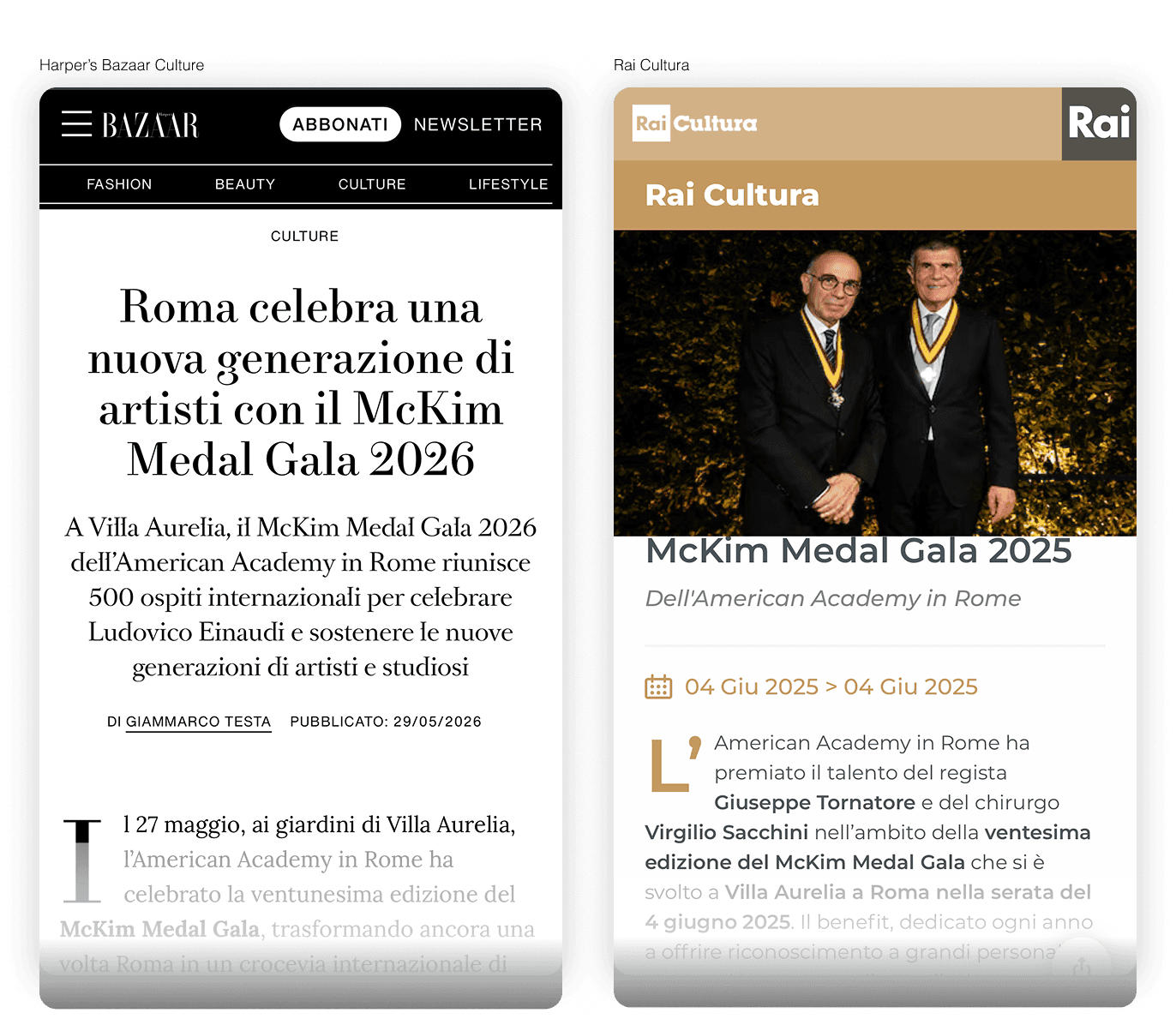
Both editions delivered on the brief. The 2025 gala sold out, honored Giuseppe Tornatore and Virgilio Sacchini, and raised over $900,000, validating the new palette's grounding in a recognizable, legacy-consistent layout. The 2026 edition drew five hundred guests, honored Ludovico Einaudi, and raised €1 million, with the motif system proving flexible enough to unify two designers' independent directions. Earned media from Vanity Fair Italia, Vogue Italia, Harper's Bazaar Italia, and Rai Cultura followed, confirming that a scalable, systemized identity can support both institutional continuity and measurable fundraising impact.